Helion Achieves Key Plasma Temperature Milestone
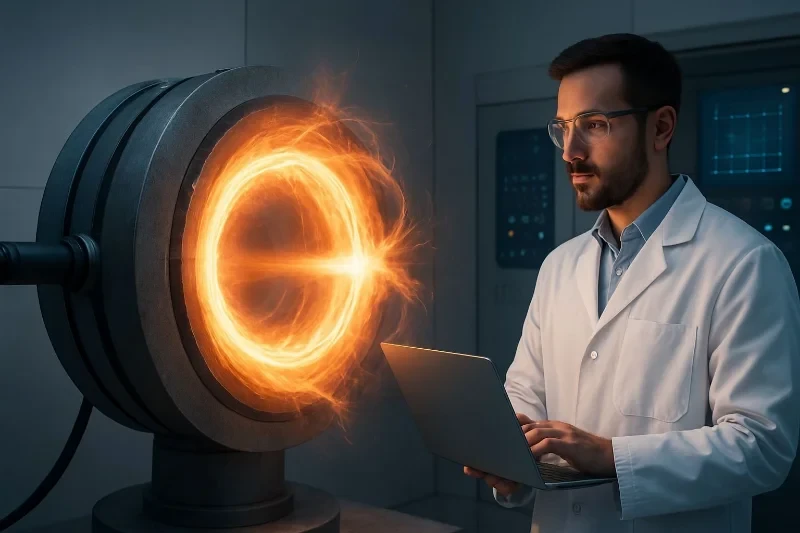
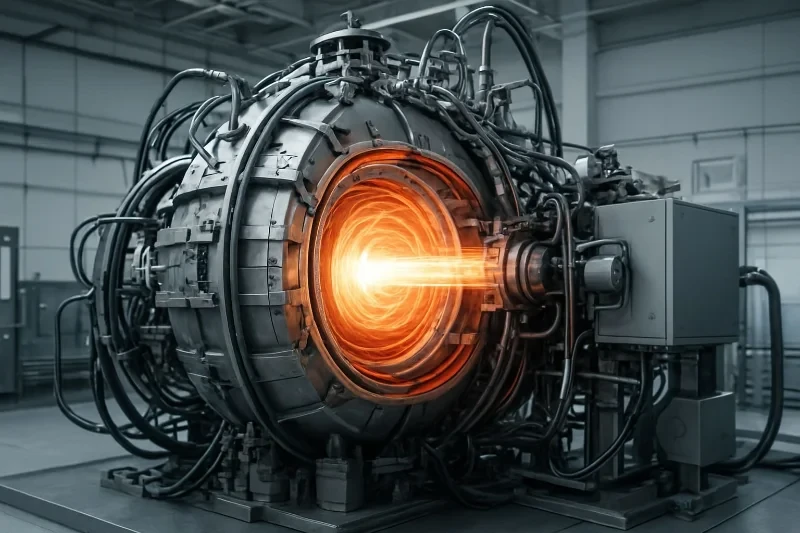
Helion, a fusion energy startup based in Everett, Washington, has announced a significant achievement in its pursuit of commercial fusion power. The company's Polaris prototype reactor has successfully heated plasma to 150 million degrees Celsius. This temperature represents three-quarters of the way towards what Helion estimates is necessary for operating a commercial fusion power plant.
"We are obviously very excited to reach this point," stated David Kirtley, Helion's co-founder and CEO. This milestone is particularly noteworthy as Polaris is operating with deuterium-tritium fuel, a mix of two hydrogen isotopes. Kirtley highlighted that this makes Helion the first fusion company to achieve this specific operational capability. "We observed a dramatic increase in fusion power output in the form of heat, as anticipated," he added.
The Race for Fusion Energy Commercialization
Helion is engaged in a competitive race with several other companies striving to commercialize fusion power, a potentially limitless source of clean energy. The immense promise of fusion has attracted substantial investor interest, with recent funding rounds bolstering the sector. Companies like Inertia Enterprises, Type One Energy, and Commonwealth Fusion Systems have all secured significant investments, underscoring the growing confidence in fusion technology.
While most fusion startups are targeting the early 2030s for grid-connected electricity, Helion has a distinct advantage with a contract to supply electricity to Microsoft starting in 2028. This power will be generated by the larger, commercial Orion reactor currently under construction, not the Polaris prototype.
Helion's Unique Reactor Design and Fuel Strategy
Each fusion startup employs distinct reactor designs, leading to varied milestones. For instance, Commonwealth Fusion Systems focuses on heating plasma to over 100 million degrees Celsius within their tokamak reactors, which use powerful magnets for plasma containment. Helion's reactor, however, utilizes a field-reversed configuration, requiring plasma temperatures approximately twice as high for optimal function.
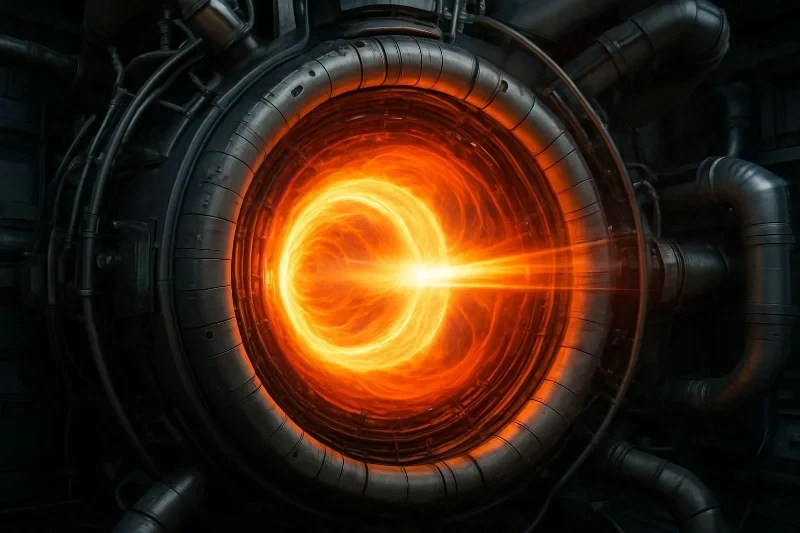
The Helion reactor chamber resembles an hourglass. Fuel is injected at the wider ends and converted into plasma. Magnets then accelerate these plasmas towards each other. Upon merging, the plasma reaches temperatures between 10 million and 20 million degrees Celsius. Powerful magnets then compress this merged plasma, increasing the temperature to the reported 150 million degrees Celsius, all within a fraction of a second.
Direct Electricity Generation and Future Fuel Plans
Unlike many competitors that aim to extract energy as heat, Helion's approach involves using the magnetic field generated by the fusion reaction itself to produce electricity directly. This method is expected to enhance efficiency. Each fusion pulse generates a magnetic field that pushes against the reactor's magnets, inducing an electrical current that can be harvested. Helion has been refining its circuits over the past year to improve electricity recovery rates.
While currently using deuterium-tritium fuel, Helion plans to transition to deuterium-helium-3 in the future. This fuel choice is advantageous because deuterium-helium-3 fusion produces more charged particles. These particles interact more effectively with the confining magnetic fields, aligning with Helion's direct electricity generation strategy. The company's ultimate objective is to achieve plasma temperatures of 200 million degrees Celsius, a target driven by its reactor design and fuel choice, which Kirtley believes is the optimal range for a power plant.
Helium-3 Production and Commercialization Outlook
Regarding scientific breakeven, Kirtley emphasized Helion's focus on electricity generation rather than solely scientific milestones. Helium-3, while abundant on the Moon, is not readily available on Earth, necessitating its in-house production. Initially, Helion will fuse deuterium nuclei to create the first batches of helium-3. In regular operation, while deuterium-helium-3 fusion will be the primary power source, some deuterium-deuterium reactions will also occur, producing helium-3 that can be purified and reused.
The company has reported success in refining its fuel cycle, finding the production of helium-3 to be more straightforward than anticipated, with high efficiencies in both throughput and purity. Kirtley expressed his belief that other fusion companies will eventually adopt helium-3 fuel as they pursue direct electricity recovery methods and recognize the associated efficiency gains. Helion is open to supplying helium-3 to such companies.
In parallel with its Polaris experiments, Helion is constructing Orion, a 50-megawatt fusion reactor designed to fulfill its contract with Microsoft. "Our ultimate goal is not to build and deliver Polaris," Kirtley clarified. "That is a stepping stone towards scaled power plants." Stay Tuned to Devignitor Insights for More Updates