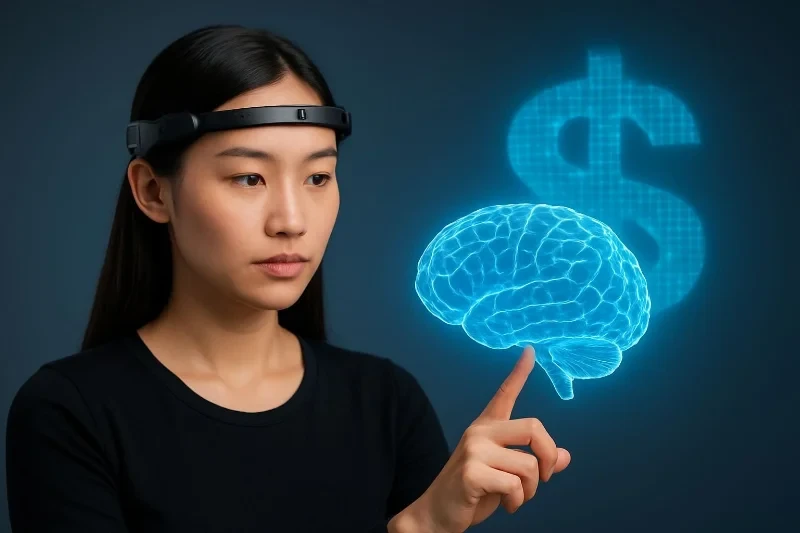
Gestala Launches with Significant Funding for Non-Invasive Brain-Computer Interface Technology
While major players like Elon Musk's Neuralink and OpenAI-backed Merge Labs push the boundaries of brain-computer interface (BCI) technology in the United States, China is rapidly emerging as a key hub for BCI innovation. Serial entrepreneur Phoenix Peng is at the forefront of this movement with two distinct startups: NeuroXess, focusing on implantable BCI systems, and Gestala, which is pioneering non-invasive ultrasound-based BCIs.
Gestala has made a remarkable entrance into the market, raising an impressive $21.6 million (CN¥150 million) just two months after its launch. This substantial seed funding round positions the company with a valuation between $100 million and $200 million, according to founder and CEO Phoenix Peng. This funding marks the largest early-stage investment in China's burgeoning BCI sector.
The funding round was co-led by Guosheng Capital and Dalton Venture, with significant participation from Tsing Song Capital, Gobi Ventures, Fourier Intelligence, Liepin, and Seas Capital. The round was heavily oversubscribed, with investor commitments exceeding $58 million, highlighting strong market confidence in Gestala's vision.
Peng plans to allocate the capital towards intensive research and development, expanding the Gestala team from its current 15 employees to approximately 35 by the end of the year, and establishing a dedicated manufacturing facility within China. The ambitious startup aims to have its first-generation prototype ready by the close of the year.
The global BCI industry is currently witnessing a surge of investment, particularly in ultrasound technology. While Gestala is the first ultrasound BCI company to emerge in China, it is not the first globally. Several startups in the U.S., including Merge Labs, are also exploring this promising avenue.
Peng believes that ultrasound technology represents the next frontier in BCI, offering the potential for broader, whole-brain access and novel methods for interacting with neural activity. He emphasizes that non-invasive ultrasound technology could overcome one of the most significant adoption hurdles for BCIs: the inherent risks associated with brain surgery. Unlike implanted electrode systems, ultrasound can monitor a larger area of the brain, including deeper neural circuits. Furthermore, by employing phased-array ultrasound, the system can precisely stimulate or suppress neural activity without surgical intervention.
Despite increasing geopolitical tensions, Peng expresses hope for continued collaboration between the U.S. and China in deep-technology research. "Both countries bring different strengths," Peng stated. "China offers large-scale clinical research capacity and efficient supply chains, while the U.S. has world-class scientific talent." He also believes that joint efforts could accelerate the building of large clinical datasets essential for global neuroscience research.
Gestala is exploring a diverse range of applications for its technology. Medically, its lead program focuses on chronic pain management, a condition affecting vast populations in both the U.S. and China. Existing academic research suggests that ultrasound stimulation can significantly alleviate pain levels. The startup is also investigating applications for mental health conditions such as depression, PTSD, autism, and OCD, as well as stroke rehabilitation. Longer-term targets include neurodegenerative diseases like Alzheimer's, essential tremor, and Parkinson's disease. While the company is researching six to eight potential indications, most are still in the early research phase.
Gestala asserts that its competitive advantage lies in its speed and scalability, leveraging China's integrated manufacturing ecosystem to accelerate the transition from development to production more rapidly than many international competitors. The company is also partnering with major Chinese hospitals to expedite clinical trials at a fraction of the cost compared to studies in the U.S. or Europe, estimating costs to be around 20% to 33%. Concurrently, Gestala is building an "Ultrasound Brain Bank," a substantial clinical dataset designed to train AI models for decoding brain signals and supporting future neurological diagnostics.
Stay Tuned to Devignitor Insights for More Updates