Is Your npm install Starting to Feel Like a Game of Russian Roulette?
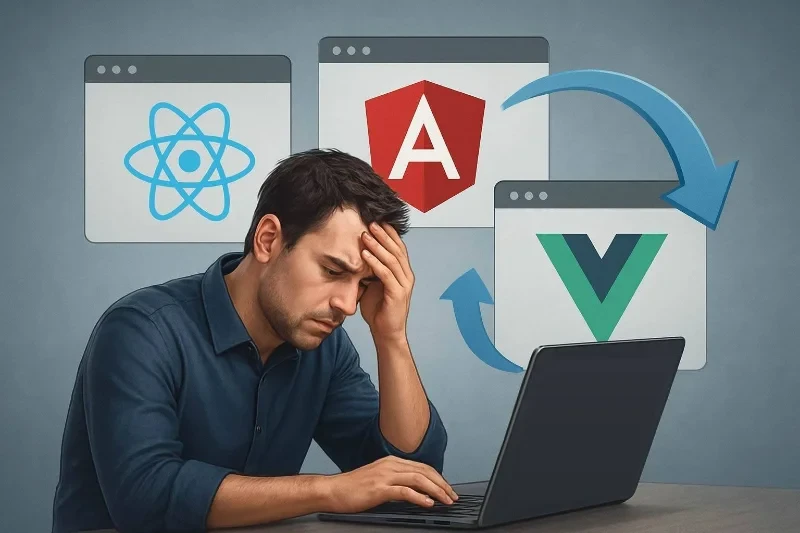
Have you ever spent an entire weekend mastering a new syntax, only to wake up on Monday morning to a Twitter thread explaining why that framework is now legacy code? In the world of web development, we do not just write code. We live in a perpetual state of Framework Fatigue, where the shelf life of our tools feels shorter than the milk in our refrigerators.
Welcome Back to Devignitor’s Insights
Today, we are diagnosing the fever that has gripped the JavaScript ecosystem for more than a decade. In 2025, the Framework Wars have reached a strange stalemate. Not because we found the perfect tool, but because we finally understand the Secret Sauce behind why frameworks rise and fall in the first place.
The Darwinian Lifecycle, Why They Rise
Every JavaScript framework begins with a grievance. A developer inside a big tech company gets tired of the boilerplate in React or the complexity of Angular and thinks, There has to be a better way.
Most successful frameworks follow the same formula.
- The One Thing Innovation:
- Svelte promised no virtual DOM. SolidJS promised fine grained reactivity. Astro promised zero shipped JavaScript. Each one solved a single pain point better than the Big Three.
- The Developer Experience Bait:
- New frameworks often win because they look cleaner in a code editor. They replace fifty lines of configuration with a single keyword.
- The Hype Cycle:
- Early adopters, the pioneers, start blogging about it. Soon every CTO feels the pull of FOMO, the Fear Of Missing Out.
The Gravity of the Ecosystem, Why They Fall
If the rise is powered by innovation, the fall is almost always caused by Ecosystem Gravity.
A framework is only as strong as its collection of boring tools. Date pickers, form validators, table components, and charting libraries. This leads to what we call the Chart Paradox. A new framework may be twenty percent faster, but if it lacks a reliable data table or Google Maps integration, it will never survive inside enterprise products.
The collapse begins when the Newness fades. Teams realize they are spending more time writing custom integrations than building their actual product. This triggers The Great Recalibration, when developers quietly migrate back to mature platforms like Next.js or Nuxt, simply because they want to ship.
The 2026 Vibe Shift, The Return to Vanilla
The most important change we are seeing this year is a rebellion against abstraction itself. We call it the Vanilla Correction.
For years, frameworks existed to patch missing browser features. In 2025, the Hidden Language of the web, HTML, CSS, and JavaScript, has matured. With Native Web Components, CSS Nesting, and Scoped Custom Elements, the need for a heavy framework to do basic things has largely disappeared.
The Secret Sauce:
Senior developers are no longer chasing the fastest framework. They are choosing tools that stay closest to Web Standards. A Web Standard does not ship a Version 2.0 that breaks your entire application overnight.
How to Survive the Fatigue
- Learn the Primitive: If you understand how a browser schedules a Task, you can switch frameworks in a weekend
- The 2 Year Rule: Never ship a production critical app on a framework that has not been stable for at least twenty four months
- Bet on Compilers: The future is not about shipping frameworks. It is about compiling them away. Tools like the React Compiler prove we can have the DX of a framework with the performance of Vanilla JavaScript
Frameworks will continue to rise and fall like the tide. Your job is not to catch every wave. It is to build a boat that can float on any of them.