The Persistent Challenge of Fusion Power Costs
The fundamental question in the pursuit of fusion power remains: how can the cost of initiating a fusion reaction be less than the revenue generated from the power produced? This economic hurdle is a significant bottleneck for widespread adoption of this promising energy source.
While many companies are exploring various avenues to achieve commercially viable fusion, Pacific Fusion has recently announced experimental results that could significantly lower the complexity and cost of their approach. These findings, shared exclusively with TechCrunch, point towards a more streamlined path to fusion energy generation.
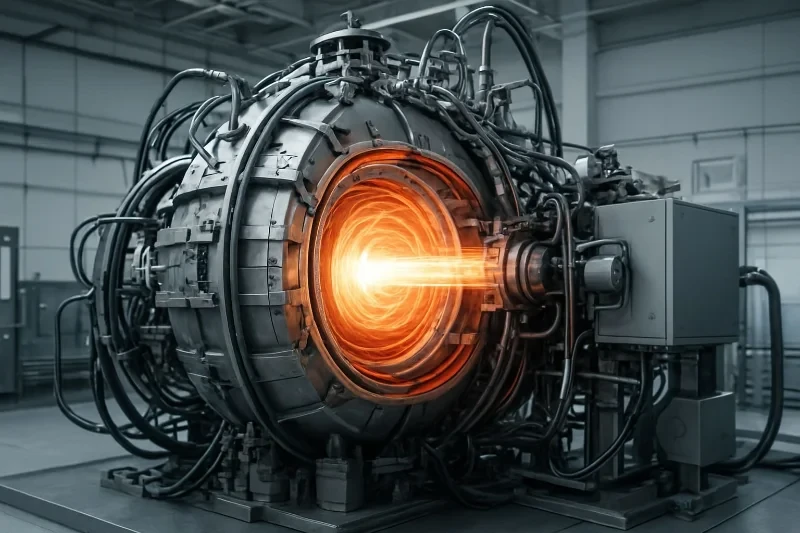
Pacific Fusion is pursuing a method known as pulser-driven inertial confinement fusion (ICF). This technique is conceptually similar to experiments conducted at facilities like the National Ignition Facility (NIF). The core idea involves rapidly compressing small fuel pellets. This intense compression forces atoms within the fuel to fuse, releasing substantial energy.
Electricity Pulses Replace Lasers
Unlike NIF, which relies on powerful lasers to initiate compression, Pacific Fusion aims to use massive electrical pulses. These pulses generate a magnetic field that envelops the fuel pellet, roughly the size of a pencil eraser. The magnetic field drives rapid compression, occurring in less than 100 billionths of a second.
"The faster you can implode it, the hotter it’ll get," explained Keith LeChien, co-founder and CTO of Pacific Fusion.
A historical challenge with pulser-driven ICF has been the need for an initial 'kickstart' to achieve the necessary temperatures for fusion. Traditionally, researchers have employed both lasers and magnets to preheat the fuel pellet before the main compression pulse. This preheating step, accounting for about 5% to 10% of the total energy, adds complexity, cost, and maintenance overhead to the fusion reactor system.
Innovative Magnetic Field Leakage
Pacific Fusion's recent experiments at Sandia National Laboratory focused on optimizing the cylindrical casing that holds the fuel pellet and refining the electrical current delivery. Their key innovation involves allowing a controlled portion of the magnetic field to 'leak' or 'seep' into the fuel pellet before the primary compression pulse. This pre-leakage gently warms the fuel, achieving the necessary preheating conditions without separate laser or magnet systems.
"We can make very subtle changes to how this cylinder is manufactured that allow the magnetic field to leak or to seep into the fuel before it’s compressed," LeChien stated.
Precision Manufacturing for Cost Efficiency
The fuel is housed within a plastic target encased in aluminum. By precisely controlling the thickness of the aluminum layer, Pacific Fusion can modulate the amount of magnetic field that reaches the fuel. LeChien noted that the required manufacturing precision for this casing is comparable to that for a .22 caliber bullet casing, a level of precision that has been refined over more than a century of industrial practice.
Minimal Energy Impact, Maximum Cost Savings
Crucially, these modifications do not substantially increase the energy required for the main fusion reaction. "It doesn’t take much energy to actually allow that magnetic field into the center of the fuel," LeChien commented. "It’s a tiny fraction, much less than 1%. It’s a very, very, very small fraction of the overall energy in the system, so it’s effectively unnoticeable."
Significant Cost Reductions
Eliminating the need for a dedicated magnetic preheating system would simplify the reactor's design and reduce maintenance. While this offers a modest cost saving, the most significant financial impact comes from potentially discarding the expensive preheating lasers. "The scale of laser needed to preheat these types of systems at high gain is north of $100 million," LeChien highlighted.
Validating Simulations with Real-World Experiments
Experiments like these are vital for refining the company's computational simulations, ensuring they accurately reflect real-world performance. "A lot of people have simulated things and said, 'Oh, this will work or that will work,'" LeChien said.
"It’s a very different game to simulate something, build it, test it, and have it work. Closing that loop is hard."
Stay connected with Devignitor Insights for more interesting stuff.