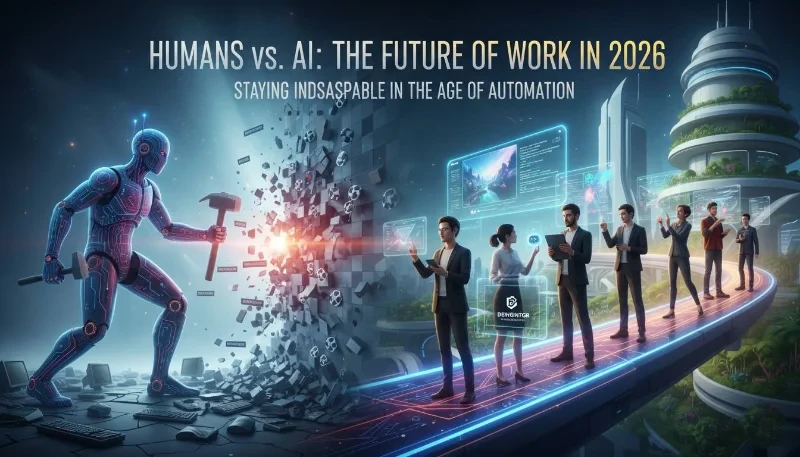
In 2026, artificial intelligence is no longer a futuristic promise it's reshaping industries at breakneck speed. From game development pipelines automating asset creation to software coding assisted by agentic AI, developers and workers across sectors face a pivotal question: can humans outpace machines and remain indispensable? The answer isn't a simple yes or no. While AI threatens displacement in routine tasks, proactive upskilling, policy interventions, and human-centric strengths offer a clear path to relevance. AsDevignitor Analysis, we see this as an opportunity for developers to leverage AI tools to amplify creativity, not replace it.
The Alarming Scale of AI-Driven Job Displacement
AI's impact on employment is already tangible. A Harvard Business Review analysis reveals that 60% of organizations have reduced headcount 39% with low to moderate cuts and 21% with large ones anticipating AI's potential rather than its current output. Tech giants like Ford, Amazon, Salesforce, and JP Morgan Chase have signaled white-collar roles vanishing, hitting entry-level programming and customer service hardest. The World Economic Forum's 2025 survey of over 10,000 executives predicts AI displacing 92 million jobs by 2030 while creating 170 million new ones, but in a "displacement" scenario, automation outpaces reskilling, exacerbating inequality.
Globally, the IMF warns that nearly 40% of jobs are exposed to AI changes, with entry-level positions most vulnerable. Regions with high AI skill demand see 3.6% lower employment in AI-threatened occupations after five years. Studies project up to 25 million jobs replaced by AI agents in 2026 alone, underscoring urgency for game devs optimizing levels or web developers building UIs tasks increasingly automated.
Who Faces the Greatest Risk? Vulnerable Occupations Exposed
Not all workers are equally threatened. Brookings and NBER research on U.S. data identifies 37.1 million workers in high AI-exposure roles, but 26.5 million possess above-median "adaptive capacity" factoring savings, age, skill transferability, and local job markets. These individuals can pivot effectively.
However, 6.1 million (4.2% of the workforce) combine high exposure with low adaptability, primarily in clerical realms like office clerks (2.5 million), secretaries (1.7 million), receptionists (965,000), and medical admins (831,000). For developers, this mirrors routine coding or testing jobs, where AI excels but innovation lags.
| Occupation Group | Workers at Risk (Millions) | Key Vulnerabilities |
|---|---|---|
| Office Clerks | 2.5 | Low savings, limited skills transfer |
| Secretaries & Admin Assistants | 1.7 | Narrow reemployment options |
| Receptionists & Info Clerks | 0.965 | High automation potential |
| Medical Secretaries | 0.831 | Prolonged job searches likely |
UN and IMF Call for Human-Centered AI
The United Nations prioritizes human rights in AI governance. UNESCO's 2021 ethics recommendation demands banning tools undermining dignity, equality, or freedom, with governments enforcing oversight. UN Secretary-General António Guterres insists on human control over AI decisions to protect rights. A "people-first" approach ensures inclusivity amid automation's social fallout.
The IMF echoes this, urging redesigned education for cognitive, creative, and technical skills that complement AI. Their Skill Imbalance Index reveals mismatches in AI readiness, stressing retraining for displaced workers and policies sharing AI gains broadly.
"Policy choices made today can turn disruption into opportunity." – IMF on AI and the future of work
Strategies for Developers and Workers to Thrive
Beating AI means embracing it strategically. Here's how:
World Economic Forum scenarios warn of "Age of Displacement" risks like talent shortages and power concentration, but optimistic paths emerge with balanced adoption.
Human Ingenuity Wins in an AI World
Workers can absolutely beat AI and stay relevant in 2026 by transforming threat into advantage. While 40% of jobs face upheaval and millions risk obsolescence, 70% of high-exposure U.S. workers hold adaptation edges.
Stay ahead with Devignitor Insights your source for developer empowerment in the AI era.