If you are building for the web in 2026
You know the headache of distinguishing a legitimate AI shopping assistant from a malicious scraping bot. The agentic web is here, and traditional bot defense is failing. At Google Cloud Next '26, Google officially evolved reCAPTCHA into something entirely new: Google Cloud Fraud Defense. We have been watching the rise of autonomous agents break standard authentication flows, so a dedicated trust platform for this new era is a necessary pivot. Here is exactly what is changing and how it affects your current integrations.
News Summary
At Google Cloud Next '26 on April 23, 2026, Google announced the launch of Google Cloud Fraud Defense. This isn't just a rebrand of reCAPTCHA; it is a fundamental shift in how applications handle risk management.
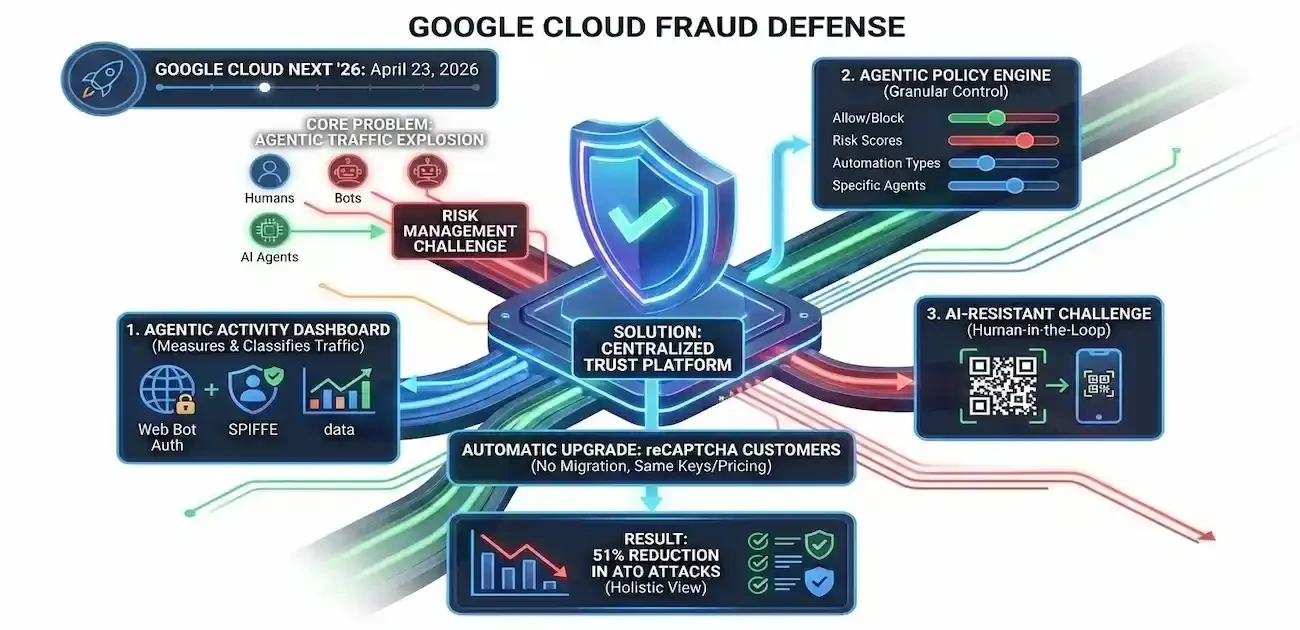
The core problem Google is addressing is the explosion of agentic traffic. While AI agents enhance customer experiences, they introduce massive fraud vectors. To fix this, Fraud Defense verifies the legitimacy of bots, humans, and AI agents through a centralized trust platform.
The new suite introduces three major capabilities. First, an agentic activity dashboard measures and classifies traffic using industry standards like Web Bot Auth and SPIFFE. It connects agent and human identities to quantify risk and trust.
Second, Google shipped a new agentic policy engine. This gives developers granular control over user interactions. You can allow or block agents based on conditions like risk scores, automation types, and specific agent identities.
Third, the platform introduces an AI-resistant challenge. When the system suspects malicious automation, it forces a human-in-the-loop verification via a new QR code-based challenge. Users scan the QR code with their mobile device to prove human presence, which breaks the economics of automated fraud.
The best part is that existing reCAPTCHA customers are automatically upgraded. There is no migration required, no action needed, and your current site keys and pricing remain exactly the same. Google claims this unified holistic view has already demonstrated a 51% average reduction in account takeover (ATO) attacks.
Developer Impact
What this means for developers: The immediate win is zero migration friction. Your existing frontend implementations automatically benefit from the upgraded intelligence network.
However, the real impact is in the new policy engine. If you are building an e-commerce SaaS or a highly targeted API, you no longer have to rely on binary "human or bot" assumptions. You can now explicitly whitelist known, legitimate AI agents like shopping assistants while aggressively blocking automated credential stuffers.
The shift to Web Bot Auth and SPIFFE standards means you can programmatically define trust boundaries for agentic traffic. Expect to spend less time tuning custom rate limits and more time writing declarative trust policies in the Google Cloud Console. Your mobile web flows also need to be rock solid, as users will shift contexts between desktop and mobile during high-risk QR challenges.
Devignitor's Analysis
We are looking at the death of the traditional CAPTCHA puzzle, and frankly, it is overdue. Google’s pivot to Fraud Defense acknowledges that the agentic web isn't a future state it is the current reality.
This move is a massive net positive for the developer community. By classifying traffic into humans, malicious bots, and legitimate AI agents, Google is finally giving developers the nuance they need. An AI scraping your pricing data to steal it is bad; an AI scraping your pricing data to buy your product for a user is good. Fraud Defense gives you the toolkit to tell the difference.
Comparing this to older mitigation strategies, Google is leaning heavily into identity and journey based correlation rather than just endpoint browser fingerprinting. The integration of SPIFFE is a brilliant enterprise play. It standardizes how services identify themselves, meaning agent-to-agent communication can be verified seamlessly at scale.
Our prediction? Over the next 12 months, agentic trust policies will become as standard as CORS configurations. We will likely see competitors rush to adopt Web Bot Auth. Furthermore, the QR-code human-in-the-loop challenge will become the new baseline for high-friction actions, pushing the concept of "proving you are human" strictly into the realm of possessing an authenticated physical device.
Comparison Table
| Feature | Legacy reCAPTCHA | Google Cloud Fraud Defense |
| Primary Target | Humans vs Bots | Humans, Bots, & Legitimate AI Agents |
| Challenge Type | Puzzles, Invisible | Silent Background, QR Code (AI-Resistant) |
| Traffic Classification | Binary | Granular (Risk Score, Agent Identity, SPIFFE) |
| Migration Effort | N/A | Zero (Auto-upgraded, same site keys) |
| Policy Control | Basic thresholding | Granular Agentic Policy Engine |
Code Snippet
JavaScript
// While Google handles the backend upgrade automatically,
// here is how you might handle the new granular risk scores
// returned by the Fraud Defense verification API in your Node.js backend.

async function verifyAgenticTraffic(token, action) {
  // Your existing site keys work perfectly with the new engine.
  const response = await fetch(`https://recaptchaenterprise.googleapis.com/v1/projects/YOUR_PROJECT_ID/assessments?key=YOUR_API_KEY`, {
    method: 'POST',
    body: JSON.stringify({
      event: {
        token: token,
        siteKey: 'YOUR_EXISTING_SITE_KEY',
        expectedAction: action
      }
    })
  });

  const data = await response.json();

  // Fraud Defense introduces deeper agent classification
  const riskScore = data.riskAnalysis.score;
  const automationType = data.riskAnalysis.reasons[0];

  if (riskScore < 0.3) {
    // High risk: Trigger the new QR-code human-in-the-loop flow on the frontend
    return { status: 'challenge_required', method: 'qr_auth' };
  }

  if (automationType === 'LEGITIMATE_AI_AGENT') {
    // Allow the AI shopping assistant, route to a dedicated API endpoint
    return { status: 'success', routing: 'agent_optimized_flow' };
  }

  return { status: 'success' };
}
FAQs
Q: Do I need to update my reCAPTCHA site keys for Fraud Defense?
A: No. Existing reCAPTCHA customers are automatically transitioned to Fraud Defense with no migration required, no action needed, and no change to site keys.
Q: How does the new AI-resistant QR code challenge work?
A: When malicious automation is suspected, the system requires a human-in-the-loop by asking the user to scan a QR code with their mobile device to prove human presence.
Q: Can Fraud Defense differentiate between good AI and bad bots?
A: Yes. The new agentic policy engine uses Web Bot Auth and SPIFFE standards to identify, classify, and allow legitimate AI agents while blocking malicious ones.
Q: Does Google Cloud Fraud Defense cost more than reCAPTCHA?
A: Google has explicitly stated there is no change to pricing for existing reCAPTCHA customers transitioning to the Fraud Defense platform.
Our Take Google killing the image puzzle is the best news we've had all week. Fraud Defense forces a necessary evolution: acknowledging that AI agents are first-class citizens on the web. By giving developers granular control over types of automation rather than just a blanket ban on bots, we can finally build for autonomous users without sacrificing security. At Devignitor, we expect identity based routing for agents to be the defining DevOps trend of late 2026.