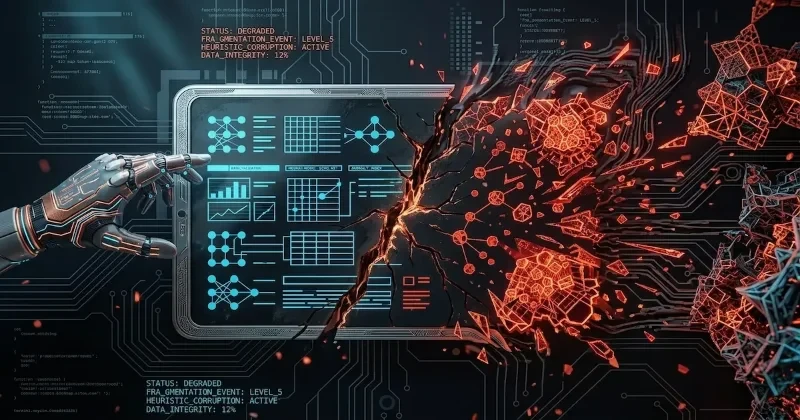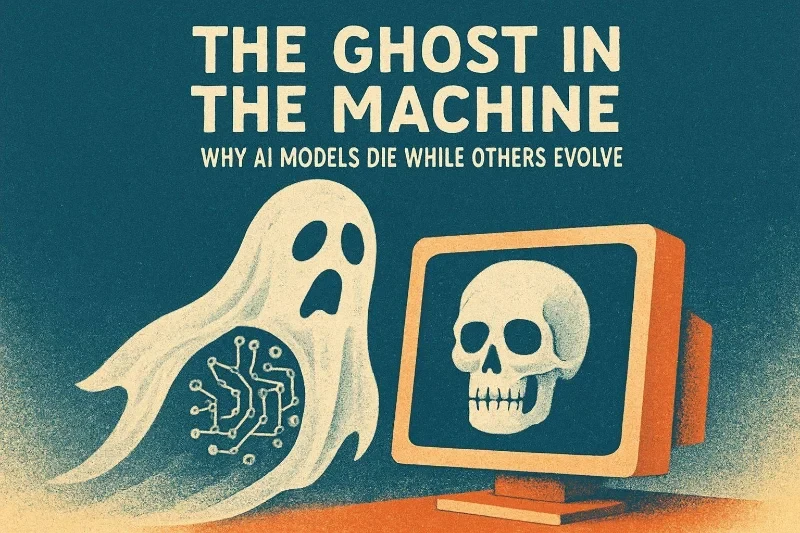
Are you ready to confront a digital haunting? Have you ever wondered what happens when the complex tapestry of an Artificial Intelligence begins to fray, or worse, to collapse entirely? We often celebrate the astonishing evolution of AI, but behind the dazzling headlines of self-improving algorithms lies a hidden graveyard of models that simply... stopped. They didn't just fail; they died.
Welcome to "Devignitor's Insights," where today we pull back the curtain on the spectral phenomenon of AI model mortality. While some AI flourishes, adapting and learning in an ever-changing digital ecosystem, others wither, becoming irrelevant, unstable, or outright defunct. Why does one AI become a phoenix, constantly reborn and refined, while another becomes little more than a digital ghost, haunting the servers it once thrived upon? The life and death of an AI model are far more nuanced than a simple bug report. It's a complex interplay of data drift, concept drift, architectural rigidity, and the often-overlooked cost of continuous learning. Let's delve into the core reasons behind this existential divide..
The Slow Fade: Data Drift and Concept Drift
Two of the most common and gradual causes of model degradation are data drift and concept drift.
- Data drift: The statistical properties of incoming data change over time. A classifier trained on historical patterns may become less accurate as real-world signals evolve—for example, spam emails, user behavior, or market trends.
- Concept drift: The relationship between inputs and desired outputs changes. The meaning of a signal (such as what constitutes fraud or user intent) can shift, making previous decision rules invalid.
Example: A spam filter trained on 2010 era email characteristics will miss modern phishing techniques; a fraud model may treat new legitimate behaviors as suspicious if the concept of fraud evolves.
Think of a model trained on outdated knowledge as a clinician using obsolete practices: not just ineffective, but potentially harmful.
Architecture Rigidity: Designed to Be Static?
Some models are deployed as static artifacts—excellent for a narrow, unchanging task but unable to incorporate new information. These rigid systems perform well only as long as the problem space remains the same.
- Highly specialized expert systems or hard-coded rules lack mechanisms for continual learning.
- Monolithic architectures are harder to update or replace incrementally.
- In contrast, modular designs and flexible neural architectures support targeted retraining and extension.
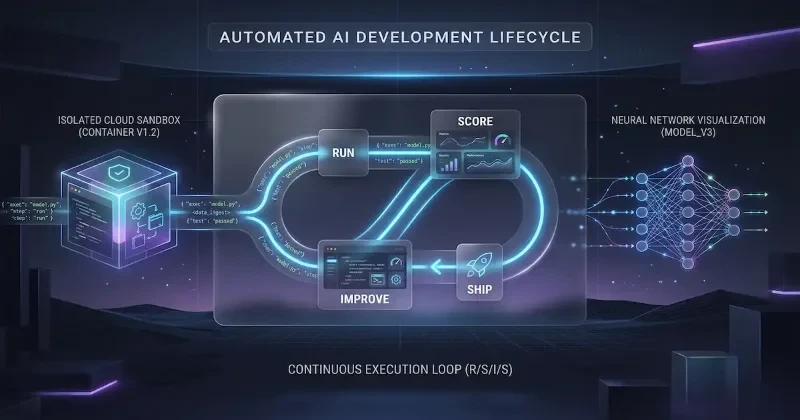
Resilient models are typically part of a broader CI/CD pipeline for machine learning: data monitoring, automated retraining, validation, and redeployment. Without these practices, even powerful models can degrade into digital ghosts.
The Cost of Immortality: Why Continuous Evolution Is Challenging
Maintaining and evolving models is resource-intensive. Not every project can justify the investment required for perpetual improvement.
| Challenge | Impact |
|---|---|
| Computational cost | Retraining large models demands significant compute, time, and memory, which can be prohibitive for smaller teams. |
| Data labeling | Concept drift often requires fresh, labeled examples; re-labeling at scale is costly and slow. |
| Versioning and governance | Managing model versions, audits, reproducibility, and rollbacks adds operational complexity and requires mature MLOps practices. |
Without sufficient investment in MLOps—monitoring, testing, deployment pipelines, and governance—even well-designed models can be lost to operational chaos.
Designing for Longevity: The Digital Phoenix
Models that remain useful over time are the result of deliberate design and organizational discipline. Key practices include:
- Robust data monitoring: Continuously track data quality and detect drift early.
- Automated retraining pipelines: Build CI/CD-like flows that enable regular or on-demand model updates.
- Flexible architectures: Favor modular, extensible designs that allow incremental upgrades and fine-tuning.
- MLOps and governance: Implement version control, reproducible training, performance testing, and rollback mechanisms.
- Labeling strategy: Adopt active learning and human-in-the-loop workflows to reduce labeling costs while keeping data fresh.
Build More Lighthouses, Fewer Sandcastles
The "ghosts" in production are a reminder that the world keeps changing. Some models are inevitable casualties when change outpaces maintenance. Others become enduring assets because teams intentionally design for monitoring, adaptability, and operational rigor. The challenge for developers and architects is clear: favor architectures and processes that enable continuous learning so more models become lighthouses robust, recalibrating, and capable of guiding us through shifting seas.