NVIDIA Vera CPU Built for Low-Latency AI Agents
We've been watching this closely, and the bottleneck in modern AI systems has officially shifted. You can scale your cluster to thousands of modern GPUs, but if your agent spends hundreds of milliseconds waiting for a sandboxed Python execution, a database query, or a JSON parsing step to complete, your architecture is bleeding efficiency. Traditional data center CPUs are built for parallel cloud multi-tenancy, not serialized, low-latency AI execution loops. NVIDIA’s newly announced Vera CPU addresses this exact infrastructure pain point by introducing a processor engineered from scratch for high-throughput, max single-threaded performance at scale.
News Summary
On July 7, 2026, NVIDIA’s Ian Buck officially introduced the NVIDIA Vera CPU, a server-class processor that establishes a brand new category: the max single-threaded CPU at scale. Designed specifically for the persistent loops of agentic AI systems, Vera aims to maximize GPU utilization by radically accelerating the non-matrix workloads that occur outside the neural network itself-such as tool calling, data processing, KV-cache management, and code execution sandboxing.
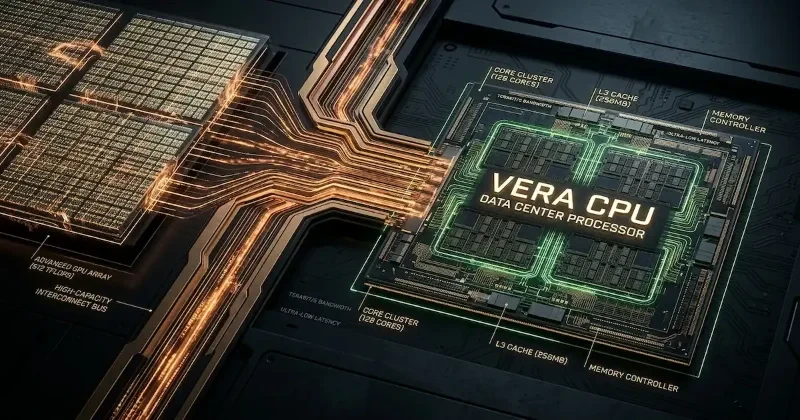
At the center of this architecture is "Olympus," NVIDIA’s custom-designed Arm-based CPU core. Olympus provides a massive 50% increase in instructions per cycle (IPC) compared to NVIDIA’s previous-generation Grace CPU architecture. The chip features 88 cores deployed on a monolithic compute die, deliberately avoiding the latency penalties and "chiplet tax" found in traditional multi-die x86 layouts. To keep these high-IPC cores constantly saturated with data, the processor provides an extraordinary $3.4\text{ TB/s}$ of core-to-core bandwidth alongside up to $1.2\text{ TB/s}$ of unified LPDDR5X memory bandwidth, while consuming under 40 watts of power for the memory subsystem.
Early industry validation shows major performance jumps. AI search company Perplexity tested Vera on real-world engineering workflows, cloning repositories and executing testing suites within isolated sandboxes. The architecture completed tasks 1.5x faster than standard x86 configurations and spun up concurrent sandboxes 1.9x faster, leading Perplexity to plan production deployments for their upcoming infrastructure. Furthermore, data workloads saw dramatic improvements, yielding up to 3x faster SQL analytics via Starburst and a 6x reduction in streaming latency using Redpanda. NVIDIA also teased its future roadmap, confirming that a next-generation "Rosa" CPU featuring an Arm v9.2 "Rigel" core is already in development to succeed Olympus.
Developer Impact
What This Means for Developers: If you are building complex AI frameworks, engineering multi-agent swarms, or writing custom tools for LLMs, compute latency is your greatest adversary. Agentic workflows do not execute as a single inference pass; they function as persistent, sequential dependency chains where the system reasons, calls a local tool, parses the output, and loops back to the model.
Vera means your sandboxed runtime environments, local subprocesses, and vector indexing operations execute with predictable, ultra-low latency. By minimizing the time spent waiting on I/O and standard serialized Python or JavaScript execution, your production agent frameworks will achieve vastly superior token-to-action speeds. This allows indie hackers and enterprise builders to deliver snappier user experiences and reduce total API or infrastructure costs by drastically lowering idle compute time.
Our Analysis
Our stance at Devignitor is highly supportive of this shift: NVIDIA is entirely correct to prioritize single-core performance over raw core counts for AI infrastructure. For nearly a decade, data center CPU design focused on maximizing multi-tenant density, cramming massive core counts into chips while compromising clock speeds, per-core cache sizes, and memory access latency. While that strategy works beautifully for hosting standard microservices or containerized web applications, it acts as a massive bottleneck for agentic systems where a single chain of thought relies on one core executing an operation as fast as humanly possible.
We predict this launch will spark an architectural race across the chip design landscape. Competitors like AMD and Intel will likely be forced to pivot away from purely high-core-count cloud designs to introduce frequency-optimized, wide-monolithic variants targeted explicitly at AI coordination nodes. NVIDIA holds a distinct platform advantage here; because Vera serves as the host CPU within the newly revealed NVIDIA Vera Rubin GPU platform and powers the BlueField-4 STX storage units, developers get an entirely unified, end-to-end architecture and toolchain.
Compared to the older NVIDIA Grace architecture, which was a highly competent chip for general cloud or data-shuffling duties, Vera's 50% IPC improvement via the Olympus core represents a fundamental reassessment of modern workload demands. It directly addresses the memory access penalties that plague traditional chiplet architectures by utilizing a massive $3.4\text{ TB/s}$ interconnected fabric across a single compute die. This ensures that even when all 88 cores are fully saturated with concurrent agent tasks, individual core performance never degrades due to resource contention.
| Specification / Metric | NVIDIA Grace | NVIDIA Vera PDF |
| Core Architecture | Custom Arm | Custom "Olympus" Core |
| IPC Improvement | Baseline | +50% vs Grace |
| Die Layout | Multi-chip / Chiplet | Monolithic Compute Die |
| Core-to-Core Bandwidth | Standard Interconnect | $3.4\text{ TB/s}$ (3x higher than standard server CPUs) |
| Total Physical Cores | Variable | 88 Cores |
| Memory Bandwidth | Standard LPDDR5X | Up to $1.2\text{ TB/s}$ @ < 40W memory power |
While you can't program a physical CPU directly via a web API, you can write highly optimized, non-blocking asynchronous runtimes designed to exploit high-speed, single-threaded execution environments. Below is a clean, dependency-free Node.js worker implementation demonstrating how an agentic loop splits AI reasoning from low-level tool execution loops.
import { Worker, isMainThread, parentPort, workerData } from 'worker_threads';

// Simulated high-speed single-threaded tool execution loop (Runs on Vera CPU Core)
if (!isMainThread) {
  const { toolName, payload } = workerData;

  // High-performance, time-sensitive parsing and computation execution
  console.log(`[Core Executing] Running tool: ${toolName}...`);

  let result;
  if (toolName === 'executeSandboxCode') {
    // Simulating deterministic execution without context-switching penalties
    const startTime = performance.now();
    result = eval(payload); // Note: Use safe sandboxes like isolated-vm in production
    const duration = performance.now() - startTime;
    parentPort.postMessage({ success: true, result, duration });
  }
} else {
  // Main Agent Orchestrator Function
  async function runAgentStep(toolName, payload) {
    return new Promise((resolve, reject) => {
      const worker = new Worker(import.meta.url, {
        workerData: { toolName, payload }
      });

      worker.on('message', (data) => resolve(data));
      worker.on('error', reject);
      worker.on('exit', (code) => {
        if (code !== 0) reject(new Error(`Worker stopped with exit code ${code}`));
      });
    });
  }

  // Example of an agent executing an internal computational step between LLM calls
  (async () => {
    const mathPayload = "(() => { let count = 0; for(let i=0; i<1000000; i++) { count += i; } return count; })()";
    console.log("[Agent Loop] LLM requested computation tool execution.");

    const taskResult = await runAgentStep('executeSandboxCode', mathPayload);
    console.log(`[Agent Loop] Tool completed execution in ${taskResult.duration.toFixed(4)}ms. Result: ${taskResult.result}`);
  })();
}
FAQs
Q: Why do AI agents care about single-threaded CPU speeds if LLMs run entirely on GPUs?
A: LLMs process tokens on the GPU, but the actual logic of taking an action-like spinning up docker sandboxes, invoking external webhooks, parsing messy files, or looking up databases—happens completely on the CPU. If the CPU takes too long to process those sequential tools, the GPU sits idle, tanking your application's efficiency and driving up system latency.
Q: What is the "chiplet tax" that NVIDIA mentions regarding standard data center processors?
A: Multi-die chiplet layouts slice up processors into distinct sections to lower manufacturing costs, but this design introduces latency boundaries. If a core on one side of a chiplet needs data residing in a memory controller on the opposite side, it hits interconnect bottlenecks, creating unstable and unpredictable processing times.
Q: Can I run standard Linux x86 developer packages on the NVIDIA Vera platform?
A: Vera is built on a custom 64-bit Arm architecture (using the Olympus core), meaning your execution environments will target Arm64 runtimes. Most modern cloud infrastructure tools, Docker containers, Node.js packages, and Python runtimes already provide first-class native compatibility for Arm-based server architectures.
Q: When will the next-generation NVIDIA Rosa CPU be available?
A: NVIDIA has officially confirmed the upcoming Rosa CPU along with its updated Rigel core architecture as the direct successor on their roadmap, but concrete release dates and exact production schedules have not yet been announced.
Our Take
NVIDIA’s introduction of the Vera CPU acknowledges an essential reality: raw GPU horsepower is useless if your infrastructure stalls out during the critical tool-execution steps of an AI workflow. By engineering a processor tailored explicitly for raw, uncompromised single-threaded performance at scale, NVIDIA is single-handedly reshaping the modern data center paradigm to support autonomous agent deployment. This isn't just an incremental patch to server-side chips; it's a structural realignment for the production-tier engineering stack. We are tracking the rollout of this unified platform closely as it begins changing real-world deployment performance