Benchmarking the Era of Agents Real-World Compute Performance
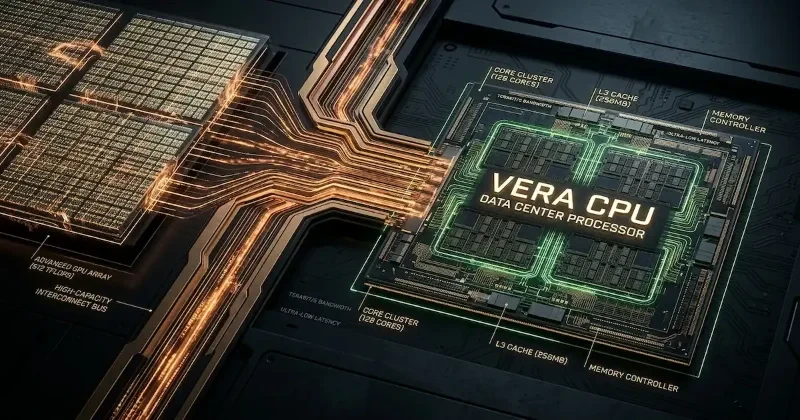
You hit a wall when raw compute cannot keep pace with your data pipelines or model complexity. We have been watching this infrastructure bottleneck closely As AI workloads shift from basic LLM text generation to complex autonomous agents and massive scientific simulations, standard data center nodes are chugging. NVIDIA just threw down a massive countermove. The company officially announced its Vera Rubin supercomputing platform, an architecture built to fuse high-precision simulation, massive data analytics, and agentic AI into a unified rack-scale system.
News Summary
NVIDIA has unveiled its next-generation Vera Rubin supercomputer platform, aiming directly at complex industrial innovation and scientific discovery. The platform is engineered specifically to accelerate workloads in the emerging "era of agents," providing the raw horsepower needed for climate modeling, computational fluid dynamics, quantum chemistry, and energy exploration.
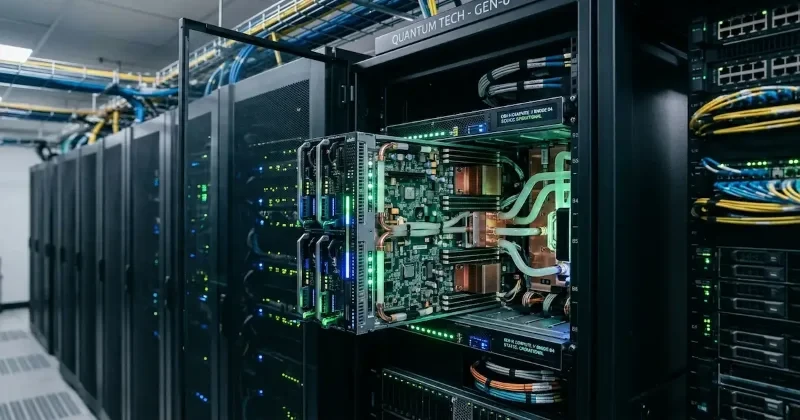
The technical specifications showcase a massive scale. A standard Vera Rubin supercomputing system scales up to 144 GPUs, supported by extreme memory bandwidth. The architecture delivers more than 7 exaflops of AI compute for scientific workloads alongside 5 petaflops of native FP64 precision support.
According to NVIDIA, this puts the rack-scale system on par with the most powerful installations listed on the global TOP500 supercomputer index. Enterprise teams and research centers can leverage this architecture to run vastly larger models with higher fidelity, cutting down verification and discovery cycles.
NVIDIA CEO Jensen Huang noted that scientific discovery has become a direct race between real-world complexity and the systems built to process it. The Vera Rubin platform acts as a unified instrument, combining simulation, data processing, and AI execution within a single rack-scale environment.
Developer Impact
While individual indie hackers won't house a 144-GPU rack in their garage, this architecture directly alters the downstream API and cloud ecosystem. If you are building SaaS platforms that rely on heavy spatial computing, AI agents, or real-time data physics, this infrastructure speeds up the underlying models you consume.
Developers engineering complex AI agent swarms will benefit from hardware optimized for multi-agent orchestration and low-latency memory paths. The native FP64 precision means engineering teams training domain-specific models do not have to compromise on mathematical accuracy to get raw speed. Expect cloud providers to integrate these clusters into high-performance tiers, lowering execution time for massive token-heavy pipelines.
Our Analysis
The tech ecosystem does not need another incremental hardware refresh, but the Vera Rubin platform is a necessary infrastructure evolution. Our take at Devignitor is clear: this is a major win for the developer community, specifically those working at the intersection of AI and physical computing. NVIDIA is effectively moving away from just selling individual chips to selling cohesive, rack-scale computing fabrics.
We predict that this architecture will accelerate the development of highly specialized, agentic AI frameworks. Current systems struggle with long-horizon reasoning tasks because the compute latency between data ingestion and inference is too high. By tightly coupling data processing and AI infrastructure, NVIDIA is clearing the hardware runway for autonomous agents that can act in real-time.
When contrasted with previous architectures like Blackwell or Hopper, the Vera Rubin platform shifts the primary focus from pure large language model training to hybrid workloads. It blends traditional simulation math (FP64) with dense AI calculations (Exaflops of AI compute). This leaves competitor platforms scrambling to match not just the silicon performance, but the unified software and network topology that makes a 144-GPU rack function as a single logical entity.
| Metric / Feature | Previous Architecture Standards (Approx.) | NVIDIA Vera Rubin Platform PDF |
| GPU Scale | Standard Multi-Node Clustering | Up to 144 GPUs per system |
| AI Performance Target | Petaflop Era Optimization | Over 7 Exaflops of AI for Science |
| Native FP64 Support | Variable by SKU | 5 Petaflops |
| Workload Architecture | LLM Training / Text Generation Focus | Integrated Simulation, Data Analytics, & Agents |
To interact with high-performance AI clusters and manage remote agent tasks on infrastructure like Vera Rubin, developers utilize optimized SDKs. Below is a mock implementation showing how to initialize a distributed simulation job utilizing a high-performance compute API client.
import os
import hpc_ai_sdk as hpc

# Initialize the client with high-performance cluster credentials
client = hpc.ClusterClient(
    api_key=os.environ.get("DEVIGNITOR_HPC_API_KEY"),
    endpoint="https://cluster.hpc.devignitor.com"
)

def launch_agentic_simulation():
    # Define workload parameters optimized for high-precision FP64 and AI analytics
    job_config = {
        "workload_type": "agentic_simulation",
        "gpu_target_count": 144,
        "precision_mode": "FP64_native",
        "dataset_uri": "s3://devignitor-climate-data/2026/matrix.bin"
    }

    print("[INFO] Submitting workload to Vera Rubin cluster...")
    job = client.jobs.create(config=job_config)

    # Monitor the execution status of the distributed system
    status = client.jobs.get_status(job.id)
    print(f"[STATUS] Job {job.id} is currently: {status.state}")

    return job.id

if __name__ == "__main__":
    launch_agentic_simulation()
FAQs
Q: What is the main purpose of the NVIDIA Vera Rubin platform?
A: The platform is a rack-scale supercomputer designed to unite high-precision simulation, AI processing, and data analytics. It is built specifically to accelerate heavy workloads like climate modeling and autonomous agent systems.
Q: How many GPUs can the Vera Rubin system support?
A: A single Vera Rubin supercomputing system can scale up to 144 GPUs with extreme memory bandwidth to handle massive models.
Q: What are the performance metrics for this supercomputing platform?
A: It delivers over 7 exaflops of AI compute performance for scientific discovery along with 5 petaflops of native FP64 support.
Q: Why does native FP64 support matter for developers and researchers?
A: FP64 provides double-precision floating-point format, which is critical for preventing rounding errors in high-fidelity scientific simulations, engineering calculations, and deep data processing.
Our Take
NVIDIA’s Vera Rubin architecture proves that the company is looking far beyond basic chatbot architectures. By optimizing hardware for autonomous agents and massive scientific simulations simultaneously, they are setting the hardware baseline for the next five years of AI engineering. If you are building models that require massive parallel processing and intense data throughput, the horizon just expanded. Rest assured, we will be tracking how cloud providers deploy these systems to ensure you have the tools and code snippets needed to exploit this performance.