Why OpenEnv and Foundry Matter for Builders
If you are building LLM-backed applications right now, you are likely stuck in a frustrating cycle: tweaking system prompts, swapping API keys, and hoping a vendor model update doesn't silently break your production code. we have been watching this shift closely. The modern AI engineering landscape is moving away from renting monolithic frontier models toward owning the entire system architecture. Microsoft’s latest announcements at Build 2026 solidify this transition. By coupling their Foundry enterprise stack with the open-source OpenEnv protocol, they are giving developers the exact blueprints needed to build autonomous, hill-climbing learning loops where the model is just a swappable component.
News Summary
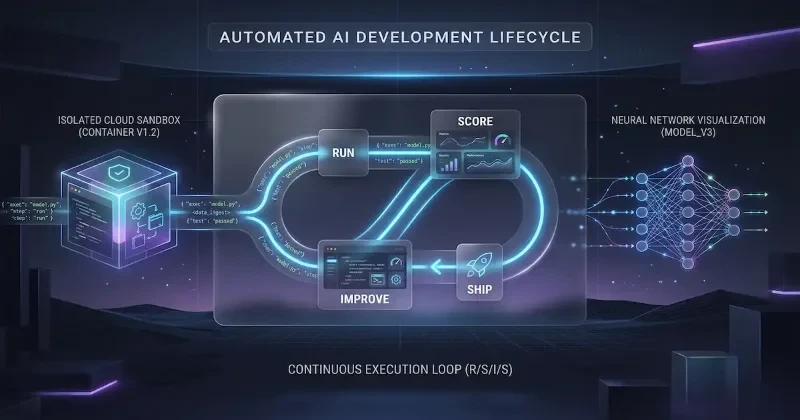
Microsoft has formally joined the OpenEnv community alongside industry mainstays like Meta’s PyTorch team, NVIDIA, Hugging Face, Unsloth, and Prime Intellect. OpenEnv operates as an open, interoperable protocol for agentic reinforcement learning environments (RLEs). It defines a standardized contract (reset, step, state) carried over the Model Context Protocol (MCP) and packaged via Docker. The core goal of this alliance is to ensure that a developer's training environment precisely matches their production runtime, preventing vendor lock-in.
As part of this initiative, Microsoft contributed two critical enterprise features directly into the open-source OpenEnv project:
- Hosted Azure Container Apps (ACA) Sandbox Provider: This brings enterprise-grade isolation to agent rollouts. Each session runs within a secure container featuring an isolated filesystem, discrete state management, and default-deny egress networking to block token exfiltration or credential theft during unverified tool calls.
- ECHO World-Modeling (RFC 010): Based on Microsoft Research's paper "Terminal Agents Learn World Models for Free," this protocol RFC transforms how agentic reinforcement learning is processed.
Concurrently, Microsoft detailed how these open standards map directly to their managed Foundry ecosystem. The system works as a continuous "hill-climbing loop." An agent executes tasks inside an ACA sandbox, producing execution traces. These runs are graded automatically via developer-defined, outcome-based rubrics using Foundry's evaluation stack.
The system then optimizes performance using a two-tiered learning approach:
- Non-Parametric Learning: Modifies the harness surrounding the model without editing weights. Using tools like Agent Optimizer and SkillOpt, the system automatically rewrites prompts, synthesizes reusable skills in Markdown, and selects the most cost-effective models.
- Parametric Learning: Modifies the actual weights of small, open models. Foundry handles this through server-side managed compute on their GPUs using a "Tinker-style" training loop (
sample,forward_backward,optim_step). This allows lightweight models like Qwen orMAI-Reasoning-1-Flashto achieve frontier-level performance on highly specific domain tasks without requiring massive infrastructure clusters. Early enterprise adopters such as McKinsey and Bristol Myers Squibb are already deploying these loops via Foundry's Frontier Tuning program.
Developer Impact
For software engineers, indie hackers, and SaaS founders, this architecture redefines the ROI of custom AI deployments. Instead of paying premium token rates for a generalized frontier model to execute complex workflows, you can build a localized OpenEnv-compatible reinforcement learning environment that codifies your specific standard operating procedures.
If your application involves intricate multi-step tasks-such as matching incoming invoices against legal contracts or executing database mutations based on natural language-you can wrap those capabilities inside an ACA sandbox. By implementing a strict scoring rubric rather than chasing public leaderboard metrics, your system automatically refines its own prompt configurations and tools. When execution volume scales, you can transition from cheap, non-parametric prompt tuning to parametric post-training. This allows you to distill those exact operational behaviors into a small, highly performant open-source model that you fully own and serve cost-effectively on managed compute hardware.
Our Analysis
our stance is clear: this is a phenomenal shift for the developer community. For the past two years, the industry has been bottlenecked by "prompt engineering wrapper" architectures. Microsoft's validation of OpenEnv treats the agent environment as code, establishing a path toward reproducible, engineering-driven AI optimization.
What makes this announcement highly compelling is the integration of ECHO world-modeling. In traditional reinforcement learning for agents, a rollout sequence consists of action tokens (generated by the model) and observation tokens (returned by the environment). Standard training algorithms mask out the observation tokens entirely, discarding the vast majority of the computed trajectory. ECHO completely flips this dynamic by adding a small, weighted cross-entropy term ($L_{GRPO} + \lambda \cdot \text{CrossEntropy}$) that forces the model to predict how the environment will react based on logits it already computed during its forward pass.
Data shows that on typical terminal agent episodes, up to 89% of the total learnable tokens are environment observations. Standard RL completely wastes this data. By keeping it, ECHO effectively doubles held-out task accuracy ($pass@1$) on benchmarks like TerminalBench-2.0 and speeds up training velocity by roughly 2.3x.
The Parametric Update: ECHO vs Standard RL (Held-Out Tasks)

Standard RL (λ=0)  [██████████████] 1.0x
ECHO (λ>0)         [██████████████████████████████] 2.0x (Pass@1 Doubles)
We predict that over the next twelve months, the market will see a massive wave of "de-frontiering" in enterprise SaaS. Developers will stop blindly routing complex tasks to costly closed-source APIs. Instead, the competitive moat will shift entirely to owning the evaluation gym and execution traces. By keeping the reinforcement learning environment open and interoperable via OpenEnv, you ensure that even if a better open-source foundational base model drops next week, your core business logic, evaluation rubrics, and custom training signals remain completely untouched. You simply swap the underlying model and keep climbing
| Feature / Attribute | Non-Parametric Learning (Harness Optimization) PDF | Parametric Learning (Post-Training) PDF |
| Model Weights | Frozen (Unchanged) | Modified (Altered via gradients) |
| Primary Tools | Agent Optimizer, SkillOpt, Foundry IQ | Tinker, ECHO, SkyRL reference stack |
| Core Artifacts | Optimized <code>system_prompt</code>, <code>best_skill.md</code> | Tailored model weights (Sovereign LLM) |
| Compute Overhead | Zero extra GPUs; execution completes in minutes | Server-side GPU training runs |
| Core Advantage | Extremely fast, highly cost-effective baseline | Exceptional generalization on held-out tasks |
The following is a minimal, conceptual Python implementation demonstrating how to inject the ECHO world-modeling loss contribution into a standard GRPO training step. This represents the one-line optimization shift that leverages environment tokens for self-supervised world modeling.
import torch
import torch.nn.functional as F

def compute_echo_loss(model_outputs, token_roles, action_rewards, lambda_constant=0.005):
    """
    Computes a unified optimizer step combining traditional action RL loss
    with ECHO environment-token cross-entropy world modeling.

    Args:
        model_outputs: Raw logits from the model forward pass.
        token_roles: Tensor identifying each token as an 'action' (1) or 'observation' (2).
        action_rewards: REINFORCE/GRPO advantages scaled for action tokens.
        lambda_constant: Scalar weight for the world-modeling loss (keep small to prevent overfitting).
    """
    logits = model_outputs.logits
    targets = token_roles.target_ids # Ground truth tokens shifted for next-token prediction

    # Standard RL Mask: Extract only the tokens written by the agent
    action_mask = (token_roles == 1)
    # Calculate traditional policy loss (e.g., GRPO/PPO) weighted by reward advantages
    standard_rl_loss = F.cross_entropy(logits[action_mask], targets[action_mask], reduction='none')
    weighted_rl_loss = (standard_rl_loss * action_rewards[action_mask]).mean()

    # ECHO Mask: Extract the environment response tokens previously discarded
    env_mask = (token_roles == 2)
    # Calculate self-supervised cross-entropy loss to build an internal world model
    echo_environment_loss = F.cross_entropy(logits[env_mask], targets[env_mask]).mean()

    # Combine losses into a single backward pass step
    # Setting lambda_constant = 0 reverts the system back to vanilla RL
    total_loss = weighted_rl_loss + (lambda_constant * echo_environment_loss)

    return total_loss
FAQs
Q: What exactly is OpenEnv and how does it relate to the Model Context Protocol (MCP)?
A: OpenEnv is an open-source protocol and community standard designed for agentic reinforcement learning environments. It uses MCP as its underlying communications layer to send standardized execution commands (reset, step, state) inside containerized runtimes like Docker, ensuring training simulations match real production environments identically.
Q: Why should I focus on non-parametric learning before attempting post-training?
A: Non-parametric learning does not alter model weights, making it incredibly fast, completely free of GPU training costs, and deployable within minutes. Tools like SkillOpt can optimize instructions and Markdown-based skill sets to lift a model's base accuracy across standard benchmarks by over 20 points without altering code or incurring inference overhead.
Q: How does ECHO train an AI model without an expensive teacher model or manual labeling?
A: ECHO utilizes next-token prediction on the environment observations that are already generated during an agent's runtime rollout. Because the model has already computed the logits for these tokens during its forward pass, adding a small cross-entropy loss function forces the policy to learn how its environment responds for free, without needing external labels.
Q: Will the ECHO environment loss cause my custom model to overfit?
A: Yes, if the scalar weight ($\lambda$) is set too high, the model will aggressively overfit to the training environment's specific token structure. Empirical testing shows that keeping $\lambda$ exceptionally small (sweeping between $0.005$ and $0.05$) yields optimal generalization while avoiding model collapse on real-world, high-entropy tasks.
Our Take
Microsoft's partnership with OpenEnv and the deployment of Foundry’s optimization stack marks a massive win for open-source AI development. By standardizing the environment layer, developers are finally handed the keys to build durable, recursive self-improving systems that outlast any individual foundational model lifecycle. Treat your prompts and infrastructure as a single, cohesive gym. Optimize the harness first, harness the free data signal inside your environment traces via ECHO, and build a loop that stays completely yours. We will be tracking the expansion of the OpenEnv spec closely as it rolls out across more production developer frameworks.