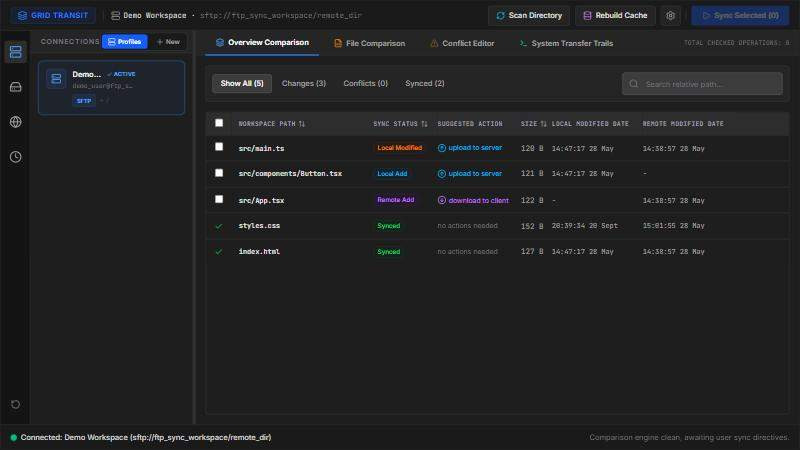
If you've ever pushed a file to a live server and immediately regretted it, you already understand why we built Grid Transit. It's a free, open-source FTP/SFTP/FTPS sync client that does something most file transfer tools never bothered to: it shows you exactly what's different between your local files and your remote server before you commit to a sync — and it gives you a real way to resolve conflicts instead of just guessing which version wins.
Grid Transit is now live at grid-transit.devignitor.com, free to download for Windows.
The Problem: FTP Clients Haven't Evolved
Anyone who deploys code over FTP, SFTP, or FTPS knows the drill. You open a traditional FTP client, you see two file trees — one local, one remote — and you drag files across. That's essentially the same workflow FTP clients have offered for over two decades.
The trouble is, that workflow tells you almost nothing. A classic FTP client can't tell you what actually changed inside a file. It can't warn you when the same file has been edited on both the server and your machine. And when two people — or one forgetful developer — touch the same remote file directly, most FTP clients will happily let you overwrite it without a second thought.
That gap is the entire reason Grid Transit exists. We wanted a file sync client for developers that behaves less like a blind drag-and-drop tool and more like a version-control-aware assistant — one that treats every sync as something worth reviewing first, not just executing.
This matters most in the exact situations where FTP and SFTP still dominate: shared hosting, cPanel deployments, legacy PHP projects, and agency work where a client might log in and tweak a file directly on the server. In all of these cases, a single careless upload can silently wipe out someone else's work. Grid Transit was built to make that mistake much harder to make.
Features That Actually Solve the Problem
Grid Transit isn't trying to reinvent FTP — it's trying to make syncing over FTP, SFTP, and FTPS safe and transparent. Here's what that looks like in practice:
- Side-by-side diff viewer — Powered by the Monaco editor (the same engine behind VS Code), Grid Transit lets you inspect real, line-by-line differences between your local file and the remote version before any transfer happens.
- Built-in conflict merge editor — When a file has changed on both sides, Grid Transit doesn't force you to pick a winner blindly. It opens a git-style merge editor so you can combine both versions by hand.
- Full protocol support — Connect over SFTP (SSH-based), plain FTP, or encrypted FTPS, whichever your host requires.
- Two-phase scan engine — Directory scans return an instant file listing first, then quietly compare file contents in the background, so the interface never freezes while comparing large projects.
- Smart exclusion filters — Keep
- Selective bulk sync — Filter by changed, conflicting, or already-synced files, select exactly what you want, and execute uploads, downloads, and deletions together.
- Transfer history and audit logs — Every upload, download, and deletion is logged with a timestamp and result, giving you a real record of what happened to your server.
Who Grid Transit Is Actually For
Grid Transit was designed around real deployment habits, not theoretical ones. A few use cases stand out:
Shared-hosting web developers. If you're pushing PHP, HTML, or CSS changes to a cPanel host without a full CI/CD pipeline, Grid Transit lets you see exactly what's different before it goes live — no more guessing what you last uploaded.
Freelancers and agencies. Managing multiple client sites means managing multiple connection profiles, and it often means a client has manually edited something on the server. Grid Transit's conflict detection catches that before you overwrite it.
Staging-to-production comparisons. Before a release, diffing a staging directory against production is a fast way to catch drift, forgotten files, or changes that shouldn't have shipped.
Teams that share server access. Whenever more than one person can touch remote files directly — a common reality with shared hosting — conflict detection stops silent, accidental overwrites.
Why We Made It Open Source
Grid Transit is released under the MIT License, which means it's free to use personally or commercially, free to modify, and free to redistribute — the only condition is keeping the original copyright notice intact.
We chose open source deliberately. A tool that manages your server credentials and decides what gets overwritten on a live site deserves to be inspectable. Anyone can read the source, verify how connection profiles are stored, and confirm exactly what happens during a sync. There's no telemetry, no account requirement, and no hidden network calls — what you see in the code is what runs on your machine.
The project is built with a modern, familiar stack: React and Vite on the frontend, Node.js and Express on the backend, Monaco Editor for diffing and merging, and Electron for native Windows packaging. If you're comfortable with that stack, contributing is straightforward.
Get Grid Transit
Ready to stop syncing blind? Here's where to go next:
- 🌐 Website & Download:
- 📖 Documentation: step-by-step setup guide available directly on the site
- 💻 Source Code: open source under the MIT License
Grid Transit is currently available as a portable executable and a guided installer for Windows, with no account, subscription, or sign-up required.
Final Thoughts
FTP and SFTP aren't going away — too much of the web still runs on shared hosting and direct server access to pretend otherwise. But the tools we use to manage that workflow haven't kept pace with how careful modern developers expect to be with their code. Grid Transit is our attempt to close that gap: a free, open-source sync client that treats "what changed" as a question worth answering before you hit sync, not after something breaks.
If you deploy over FTP, SFTP, or FTPS and you've ever been burned by an accidental overwrite, give Grid Transit a try — and if you find it useful, contribute back.