How Procedural Memory Fixes LLM Context Bloat
Imagine deploying an autonomous agent to refactor a legacy codebase, only to watch it burn through thousands of context tokens repeating the exact same syntax error across ten different files. We have been watching this limitation closely at Devignitor. While retrieval-augmented generation handles static facts, LLM agents have historically lacked a persistent way to remember how to execute tasks efficiently. The core team behind MemGPT just dropped an architectural update addressing this exact bottleneck by introducing native, long-term procedural memory stores built directly into the agent lifecycle.
Summary
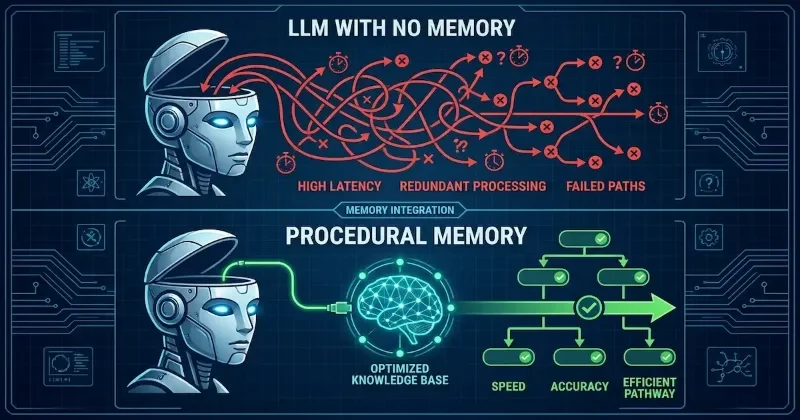
The creators of MemGPT have officially updated their stateful agent framework to support a decoupled memory architecture featuring dedicated procedural memory stores. Traditionally, large language models operate under a "No Memory" constraint during complex planning or tree-search tasks. When an agent attempts to solve a problem without historical execution data, it must evaluate multiple logic branches sequentially. This brute-force approach frequently encounters dead ends, causing high latency, token inflation, and structural inaccuracies during multi-step reasoning.
The new MemGPT architecture integrates a procedural memory layer directly underneath the primary LLM reasoning engine. When an agent successfully navigates a complex multi-step decision tree, the exact execution path is compiled and saved into a persistent procedural memory store. If the agent encounters a structurally similar task or programming problem in a future session, it bypasses iterative branch evaluation entirely.
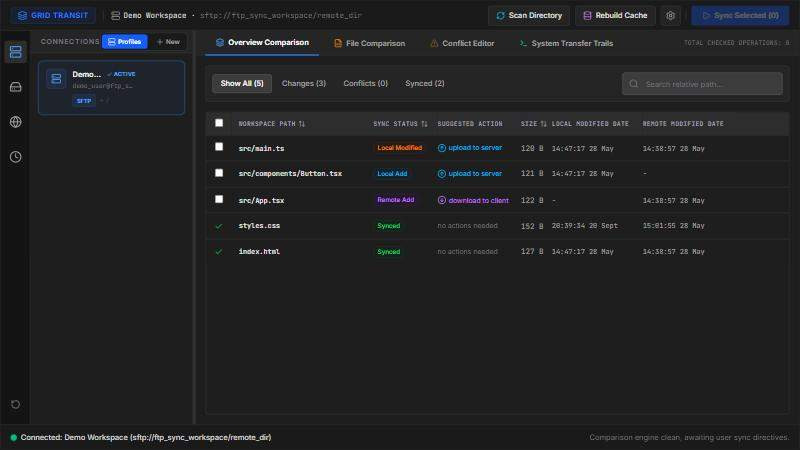
Instead of re-calculating the entire tree, the agent fetches the cached workflow path from its procedural store. This structural shift transforms how agents handle multi-tenant environments. Developers can now manage multiple isolated memory stores from a centralized administrative dashboard, tracking size, token efficiency, and specific memory types in real time.
Developer Impact
If you are building autonomous workflows or complex code-generation tools, this update radically alters your backend resource calculations. Passing massive system prompts packed with few-shot execution examples to keep your agent on track is a major token drain.
With MemGPT's procedural memory, you can let your agent learn optimal execution paths natively during its initial runs. This directly reduces token consumption on subsequent API calls, dropping inference latency because the LLM skips deep tree-search cycles.
Furthermore, because the memory stores are decoupled from the core agent instance, you can spin up multi-agent architectures where specialized agents share a single procedural memory store. A QA agent can immediately utilize the execution pathways learned by a debugging agent without needing a full state sync or heavy database reads.
Our Analysis
Our take on this update is highly positive, signaling a necessary shift away from generic vector search toward application-level state management for AI. For too long, the developer community relied on semantic chunking via RAG to give agents a semblance of memory. However, RAG only provides declarative knowledge (the "what"), completely failing at providing procedural knowledge (the "how"). MemGPT's explicit focus on procedural memory addresses the real bottleneck of agentic design: operational reliability.
We predict this architectural pattern will soon become standard across competitive frameworks like LangChain and AutoGen. In the near ecosystem horizon, we will likely see developers trading or open-sourcing pre-trained "procedural memory files" for specific dev tasks-such as an optimized memory store strictly for deploying microservices to AWS.
Contrasting this with previous iterations of MemGPT, which relied primarily on core memory context manipulation, this decoupled storage model makes production scaling viable. It moves memory management out of the volatile LLM context window and places it securely inside the infrastructure layer where it belongs.
| Performance Metric | Traditional LLM (No Memory) | MemGPT (Procedural Memory) |
| Search Architecture | Iterative Tree-Search / Brute Force | Cached Workflow Pathways |
| Inference Speed | Slow (High Latency per branch) | Fast (Direct execution match) |
| Accuracy Rate | Error-Prone (Hallucinates on deep trees) | High (Follows verified historical paths) |
| Token Consumption | Compounds with every failed path | Minimal after initial path discovery |
import memgpt
from memgpt.memory import ProceduralMemoryStore

# Initialize the MemGPT client
client = memgpt.create_client()

# Create a decoupled, persistent procedural memory store for dev workflows
dev_procedural_store = ProceduralMemoryStore(
    name="production_deploy_workflows",
    storage_backend="postgres"
)

# Initialize an agent configured to use the procedural memory store
agent = client.create_agent(
    name="devops_builder_agent",
    model="gpt-4o",
    memory_config={
        "procedural_store": dev_procedural_store.id,
        "enable_path_caching": True
    }
)

# The agent executes a complex tree-search task, caching the successful path automatically
response = agent.send_message(
    "Analyze the repository structure and deploy the Docker container to ECS."
)

print(f"Agent Execution Complete. Path cached to {dev_procedural_store.name}.")
FAQs
Q: How does procedural memory differ from standard vector RAG?
A: Standard RAG injects raw documents or text facts into the prompt context based on semantic similarity. Procedural memory stores the step-by-step logic pathways and execution functions that the agent verified as successful during past runs.
Q: Does using MemGPT's procedural memory increase my storage costs?
A: Yes, because you are maintaining a persistent database layer (like PostgreSQL or Vector DBs) to store the compiled execution pathways. However, this infrastructure cost is typically dwarfed by the massive reduction in LLM API token costs over time.
Q: Can multiple LLM agents share a single procedural memory store?
A: Yes, the decoupled architecture allows you to attach the same procedural memory store ID to multiple agent instances, enabling them to share optimized operational workflows.
Q: What happens if an infrastructure change renders a cached procedural path invalid?
A: If a cached pathway fails to execute correctly due to environmental changes, the agent invalidates that specific path branch, falls back to tree-search reasoning, and updates the store with a new valid pathway.
Our Take
MemGPT's transition toward decoupled procedural memory addresses the massive token and latency issues holding back production-grade AI agents. By giving models a systematic way to remember successful workflows, they move closer to true autonomous utility. We will be tracking how this architecture scales across enterprise environments closely as developers begin replacing heavy prompt engineering with elegant memory layers.